Friday, October 9, 2015

Group 2 - (Lesson 2)


Thinking on the objective, considering  appropiated activities, preparing proper material are some important details which teachers take into account when planning a lesson, specially when teaching English to children.

This class was developed by my team which is copunded by Yaneth Argueta, Gloria Gonzalez, Jacqueline Martinez, Nancy Membreño and me, Brenda Ayala. We worked on PPP Planning Framework and the topic taught was “There is- There are, using classroom objects vocabulary". I consider my teammates and I were confident at the time to teach the lesson. During a week we were preparing our lesson plan, we worked on the materials, as well we worked on the activitities which were according to each of the stages from the corresponding Planning Framework.

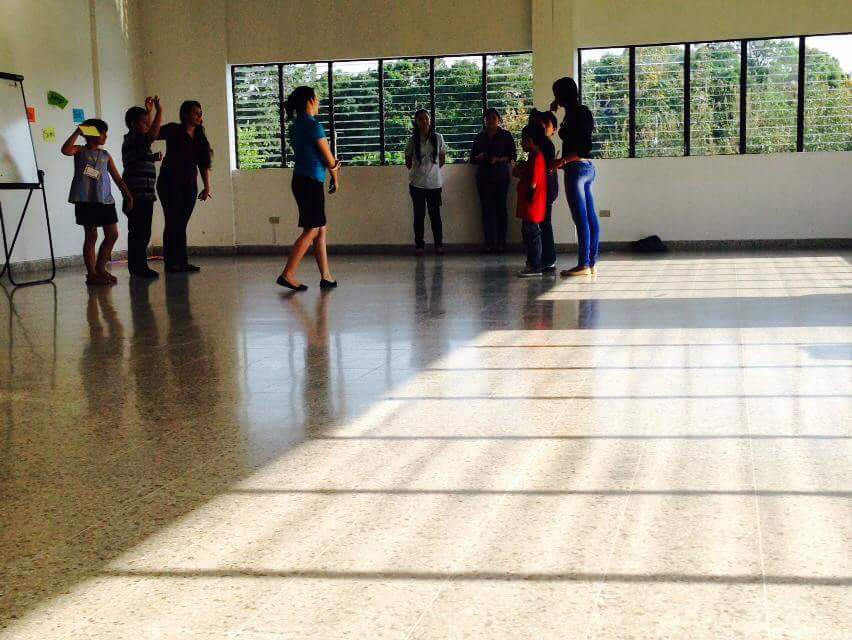
To start the class, we encouraged children to sing the “Hello-Hello” song. We asked them to make a circle in order to create a more interactive enviromnent. We were part of the circle, we mixed into the students this with the objective that children got confidence and they perceived better the mimics we did according to the song.
Besides, Yaneth Argueta was encharged of the Warm up stage. To carry out this activity we made use of a “hoop”; students had to make a line and they had to take their hands and pass the hoop throught the line with out breaking it. By the time teacher Yaneth said “stop” , she showed to the students who got the hoop a flash card with vocabulary from the last class. I could notice that children really enjoyed this game. Then,the Presentation stage was developed  by Gloria Gonzalez. She explained the topic “There is- There are” by using flashcards with an image of some classroom objects and the name of the objects in order students knew how to spell them. To be honest, I thought this topic would be difficult for children to encounter, however, they got the idea of “There is- There are” structure.
After the presentation it was time to encouraged children to practice. Nancy Membreño was encharged of this stage. She presented two different activities in order children practice forming questions and sentence using the structure and vocabulary taugh in the presentation stage. Both activities were very interactive and interesting for children because they made use of different material such as flashcards and they had to ordered a sentence an then they had to pasted it on the wall. For the second activity they used a chart and an image posted on the wall.
 
Then came the part of the production, I developed this stage. I gave children one flash card with the image about  classroom objects. They had to showed their flashcard to three different classmates in order each student wrote three different sentences using the structure studied in class. To accomplish this task, I asked them to sit on the floor in order to make them feel relaxed. I monitored them while they were writing. When they had finished the three sentences. I asked them to pass in front of the class and read one of the sentences they had written.
As a Wrap-up Jacqueline explained the “Hot- Potato” game to children in order to check what students had learned during the lesson. Finally, to close the class we sang the “See you later song”. I was excited because they already knew the song. That was great!
After finished our lesson, we received positive and constructive comments from our classmates and Teacher Ponce, as well as suggestions in order to improve future classes. Since we are not very experimented teachers yet; we skipt some details like the spelling in a flashcard used in the presentation stage, the order of some of the charts used in the Practice stage. Personally, at the end of the Production stage, I forgot to ask for the material to students and I interrupt a couple of minutes while Teacher Jaqueline was developing her corresponding stage. I also aware that we had problems in relation to time management and we had to improvise in some areas like emphasizing the pronounciation of the vocabulary. However, all those positive and constructive comments we received will help us to care of some specific details and throught practice we will gain experience to be good English teachers.

Tuesday, October 6, 2015

Group 1 - (Lesson 1)


Finally our teaching practice starts this week. It is time to demonstrate all we have learned during this course!

 The first lesson was taught by group number one, which is compounded by Eunice, Thomas, Bryan, William and Eduardo. They worked on PDP Planning Framework (listening-speaking) the topic they taught was “Classroom Actions”. I liked the activities they presented for the reason that they were according to each of the stages in the lesson plan. This group also did an great job in relation to time management. However, there were small details which could be improve such as in the “Shark” activity, the teacher asked children to walk in circles in order to form small groups. I could notice that students were walking almost in the same place, I think it could be better if teacher had made use of the available space in the classroom, and so ask children to get more separated from each other. I am considering to use this activity in future lessons in order to make the activity more interactive and funny for students due to children like to try new things and a kinesthetic activity can be interesting for them. Besides, I liked the materials this team presented in the class. Nevertheless, some of the flash cards had not the proper size for children to see the image about what the teacher was explaining. On the other hand, I consider this team did a very good job when they gave instructions to children about the different tasks students had to perform.
Personally, I liked how some teacher from this groups encouraged students to participate in the class. One important details I notice in this group was that since they were focused on speaking, I liked how teacher emphasized  the repetition of the vocabulary taught in class. Moreover, I consider important that children has to be monitores while they work in specific tasks; the team did a good job in this area.   In addition, I think that enthusiams is fundamental when working with children. I noticed that some teachers were shy and I know that nervousness is normal in the firsts classes. However, I think that teachers have to be enthusiastic in the classroom in order to transmit interest to students and so they feel they are in an interactive environment. Finally, what I learned from my classmates’ practice is the importance to pay close attention to the materials we will present in the class, they have to be with the appropiate size and catchy to the children’s sight. As well, I learned that we have to think on making correct use of the space available for each of the activities we want our students perform. We have to take into account that we are working with children, and they increase their interest on learning  when they are asked to perform kinesthethic activities. It is also pretty important to take into account the lesson’s objetive because it is our guide to develop the whole lesson. One important details I notice in this group was that since they were focused on speaking, I liked how teacher emphasized  the repetition of the vocabulary taught in class.

Friday, October 2, 2015

Diagnostic Class


Before start  planning lessons, it is important that teachers make sure about the student’s previous knowledges about some topics in the target language. A diagnostic class is always taught at the very beginning of a course, semester or  module  in order to measure students' understanding of a subject area, vocabulary or skills. During this diagnostic class, we were assigned to work in groups in order to present two different activities with two specific topics such as:
  • The numbers
  • The alphabet
  • The personal pronouns
  • Classroom objects
  • The family members
  • Action verbs, and some other topics.
The activities allowed us to know if the children had previous knowledges about the topics presented in the class. It was really interesting because some children already knew vocabulary about the different topics; however, they did not know the pronunciation of some words such as: swim, cousin, sharpener. They also got confused with some letter from the alphabet and numbers.
Moreover, even though we expected a high number of children, we only had five children in total. At the beginnig I was worried whe I saw only five students for the reason that my teammates and I had organized our activities based in the quantity of children that were supossed to be in classes. Personally, I asked myself “How are we going to form the children is small groups?” ,”How are we going to develop our activities with only  five students? . However, in that  moment I remembered something important I learned in a previous worshop with Instructor Geovany (Coping with Stage fright and How to Speak in Public). He told us “In theatre, the scene has to continue, it does not matter the circunstances and issues that arise in an unexpected moment”. In other words, unexpected problems can arise also  in the classroom. However, we need to be prepared in order to face any problem and the most important is to continue the class, it does not matter if we only have three children in the class. I think, this was a challenging scenario that we had to deal with and solved it successfully. Finally, I liked the diagnostic class because my classmates presented interesting and interactive activities which were enjoyed by the children. The materials used were according to the age of the students (color, size, design).

Friday, September 18, 2015

Coping with Stage Fright and How to Speak in Public


After two interesting, meaningful and funny workshops at the Art and Culture Departament, I really learned important things I consider important for future teaching practice.
During the workshops we did different activities. For example, Instructor Geovany asked us to walk around the classroom in order to cover all the spaces available in it. At the beginning of this acivity I did not undertand what was the purpose of it; however, I learned that it is important that teachers walk and cover all the spaces in the classroom in order to interact with all children,and not only stand at the same place.
As well, Geovany explained us that when working with children, it is important that we become children too. As we already know children do not have shame to do funny things either they have prejudice about other people.  I think that we have to be funny in our classes  in order to motivate our students. An interesting detail I learned is that if we ask our students to sit on the floor to perform a task or activity, we also have to do it for the reason that we are a model for students and they will see teacher as a friend rather that a person with authority giving instructions.

 
 Moreover, in these workshops we did some activities in order to learn how to modulate our voices in the classroom. Why is it important for teacher to know how to modulate the voice into the classroom? I learned that it is important modulate the voice according to what is being expressed. The tone of the voice can get student’s attention. It is also essential to modulate the voice in order all our students listen what we are saying, explaining, etc.

Something important I learned in the second workshop is how important is avoiding the use of "fillers" (and, but, so, and some others). Fillers make our speech repetitive and disgusting. To be honest, I know I have a good tone of voice; however, I aware that I have to modulate it in order to give some better intonation. In addition,we were working in some funny and really interesting activities. The purpose of those activities was to know how to solve different situations inmediately not only in teaching field but for everyday life. Instructor Geovany suggested us that we have to be ready and sure as possible to answer students questions, doubts and to solve problems that can arise in the classroom.
 
 
What I really like about the two workshop we has these 2 weeks was to pass to the front to tell stories in order to control our nerves, modulate our voices when standing in front of the class. I learnd from my classmates’ strengths and weknesses. Weaknesses and mistakes make us learn in order to improve and be better for life and furute teaching practice.  Finally, even thought I learned important things to put them in practice not only for teaching practice but for everyday life, I enjoyed every single activity we did in the workshops. It was a great experience, I share with my classmates, we forgot for  a while our routines, we had fun and we learned at the same time.


To summarize, it is important that we interact with our students, specially children in order to motivate them and  make them feel in an interactive environment where they can develop their language knowledges. As well, we have to take into account the importance of the way we modulate our voices according to different situations, instructions or explanations. Taking control about our nerves will also contribute to take control over our students. We do not have to forget to be a child when we work with them.

“If a child cannot learn in the way we teach, we must teach in a way the child can learn.”unknown

Tuesday, September 15, 2015

Materials


Why are materials important when teaching English to children? Do we can create the materials we will use in classes by ourselves? In this workshop, I learned how to integrate  different and creative activities by making use of materials which can be created by ourselves. One of the advantages to create our own materials for the class is that they result cheaper, catchy for student’s sight, and we can apply our creativity on them.


Materials such as flash cards can be used in order children practice vocabulary about a topic we have already taught. As well, flip cards are useful and convenient if our main objective is to allow children to practice reading skill.


Moreover, there are materials such as clay which can not be only used to ask students create a figure but to help them to develop or improve their sensory and fine - gross motor skills. An important detail about modeling clay is that can be used to calm down children. As we already know children are full of energy and sometimes they get easily distracted in class, a good way to calm them down is throught a modeling clay technique; as well they get focused when they get their hands on clay due to its texture.


Furthermore, grouping techniques are so important when teaching children. Through grouping techniques, children are able to practice the language with classmates. At the same time they can also interact to each other and work on little tasks and projects. There are different strategies we can use to create groups in our classes. For example, we can put 3  pieces of color paper in a box ans ask children to get together all color “green”, also providing pieces of paper with a half of an animal (if we will teach animals) and asks children to look for the person who was the other half of the image, and so on.

Besides, in this workshop I learned that puppets are a good strategy to motivate children, make them feel part of the class, get them interested on learning and to speak English. Puppets are an effective way to get children’s attention for the reason that they are catchy and children enjoy them.  It is important to mention that we can create our own puppets according to the topic we will teach using materials we have in home (bottons, wool, old cloth, socks, etc).

In addition, musical instruments are useful if we are looking for an activity that help our students to memorize vocabulary. I learn that musical instruments stimulate children’s learning. Instruments can be created with a can of soda, stones, seeds, sand, etc. It also can be painted with different colors and paper.
 
During this workshop, my classmates also showed an interesting material called “Spining Wheel”. I would like to use it with future students. Spining Wheel can be used to teach vocabulary such as animals, color, fruits, verbs, body parts, etc. One of the advantages of this material is that can be placed in the classrrom and adapted as many times we want according to what we are going to teach. 
 
To conclude, we are able to create material by ourselves according to the lesson we will teach. It is an important  to take into account the color and size of materials; remember that the materials we provid ein classes have to be catchy in order students get interested. There are different materials we can create by ourselves in order to get student’s attention, help them to learn the language as well to develop their fine and gross motor skills by creating an interactive environment. 

Tuesday, September 8, 2015

Speaking Activities

During this workshop, I learned different speking activities which can be used in the language classroom not only to make children feel confident about their learning, but to practice the target language and get fun at the same time. I also learned that  interaction is pretty important when teaching children due to they feel part of the group.

Besides, creativity is the key to encourage children to speak; we as language teachers are able to use many speaking activities that allow children to participate and get active in the lesson without make them feel forced.


One of the most important things I learned from this workshop is that we need to give clear and short instructions as possible for the reason that children  are beginners in the language; so that it would be difficult for them to understand and to follow our instructions. As well, it is important to make sure if children have understood instructions before performing an activity. However, we have to avoid asking questions such as “I don’t know if you understand?”. In contrast, it is better to ask more appropiate questions like “Is everything clear?” or “Is there any question?”.

Furthermore, keeping control about students and the class itself is quite difficult for teacher but it is important to teacher take control over children and how the class is going on. A good strategy I learned is to avoid show our back to children when we are explaining, writing or posting material on the board. In addition, materials are important to teach English to children. Materials (flashcards, puppets, toys, etc.) have to do with size, color and the material itself.
For example, if we will use flashcards to teach vocabulary, they have to be big enough in order all children be able to see it. As well, colors are very important in order to catch children’s attention. Finally, material such as ball, toys, dices or balloons have also be bigger for the reason that children have troubles on managing small objects.
To summarize, there are many speaking activities we can integrate into the lesson according to the topic or vocabulary we are going to teach. We also have to be very creative in order to encourage children to speak through catchy material and activities where they not just get fun but also encounter vocabulary from the target language.  

Songs and Chants


In the last few years, songs and chants have been used in English teaching, specially teaching children (young learners) because of many benefits that songs and chants bring in the language teaching field.
Definitions:
  • Chant: is simple vocabulary spoken over a background of music or rhythm. Chants are based on model of repetition and learned response.
  • Song: a short metrical composition intended or adapted for singing

It is important to mention that we teachers can add gestures to the songs or chants, like facial expressions, hand and body actions and movements. These actions help children to encounter meaning and vocabulary. Besides, clapping, dancing and playing, stimulate children to remember easier the meaning of the words.


Example of song (Children 6-9 years)


Example of chant (Children 6-9 years )


Moreover, songs and chants can be adapted depending on the topic we are teaching. I also consider a catchy rhythm of songs is very important for the reason that children feel motivate and interested on learning. In addition, teachers can integrate songs or chants in the lesson at different stages from the framework. For example, if we have already taught a topic (vocabulary), then we can look for a songs to use it as a warm up in the lesson in order to review what we studied in previous classes. On the other hand, songs and chants can be included in the during stage, if we are teaching a specific topic and we want our students get familiar with the topic and vocabulary.

Even though songs and chants are useful in English teaching practice for children, there are some negative aspects teachers have to take into account in order to avoid inconvenient when
choosing songs for young learners.


Benefits

  • To develop listening and speaking skills. Songs and chants help learners become familiar with words stress, intonation and pronunciation.
  • To stimulate children’s interest in the target language.
  • To provide a relaxed classroom atmosphere, helping teachers get closer to their students.
  • To motivate to learn and to be active.

Negative aspects
  • Song or chant should contain limited vocabulary and topics should be within the experiences of children.
  • The songs should present a limited musical challenge.
  • Audios or songs can lack of quality.
  • Songs or chants might not be according to the children’s age or level.
To summarize, teaching English through songs is useful not only to motivate children, but to help them feel part of a class. As well, to encourage them to get familiar with the target language, and expose them to the real pronunciation of words, and acquiring new vocabulary.  One important detail is that we teachers are able to adapt songs or chants according what we have to teach.